
Author: v3l0c1r


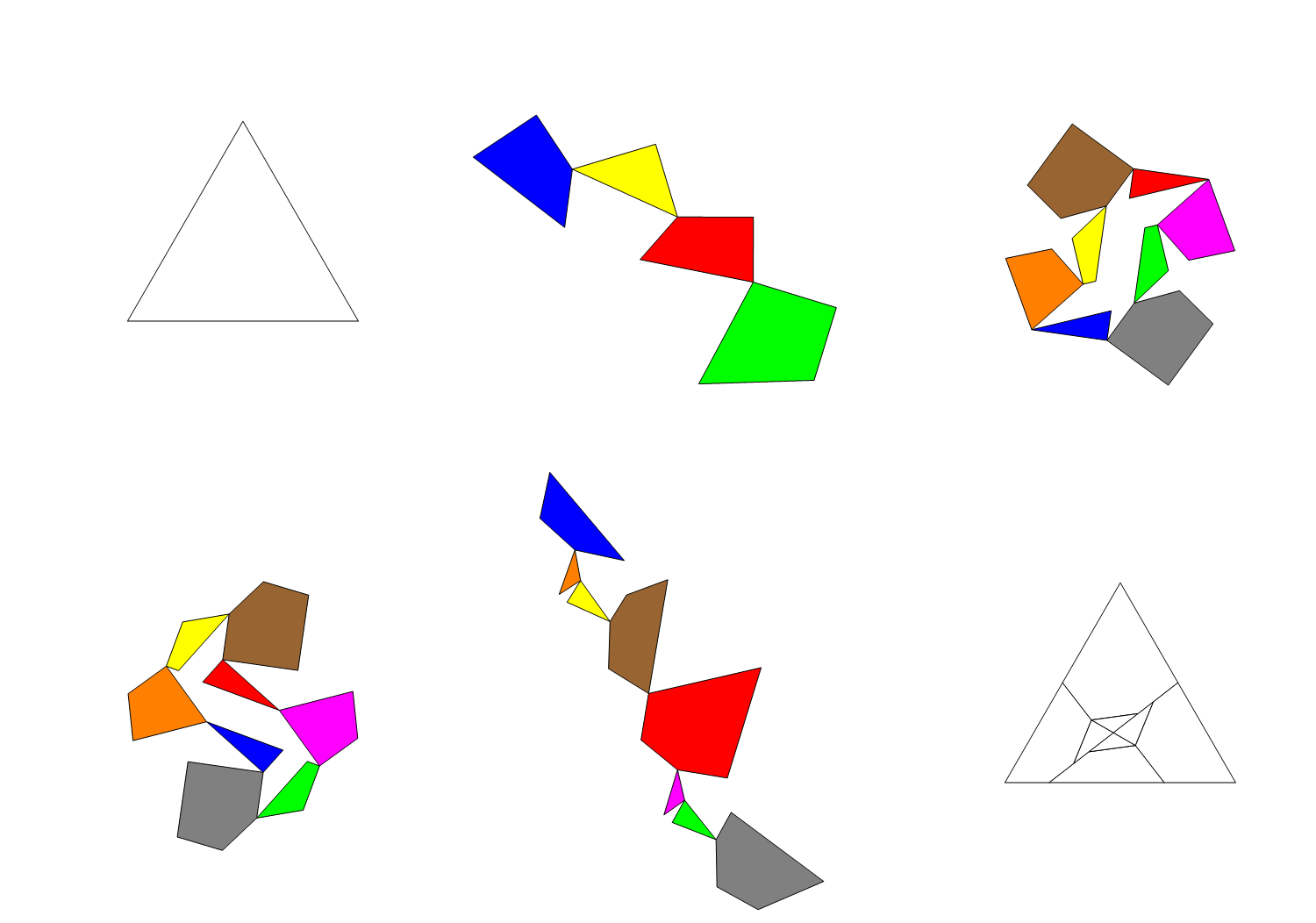
Swing-hinged dissection, or simply Hinged dissection, is the geometric dissection in which all of the pieces are connected into a chain by hinged points, such that the rearrangement from one figure to another can be carried out by swinging the chain continuously, without severing any of the connections.
Hinged dissections were popularised by author of mathematical puzzles, Henry Dudeney. He introduced the famous hinged dissection of a square into a triangle in his 1907 book “The Canterbury Puzzles”, the Hinged dissection was also named the Dudeney dissection .
The Wallace–Bolyai–Gerwien theorem, first proven in 1807, states than any two equal-area polygons must have a common dissection. However, the question of whether two such polygons must also share a hinged dissection remained open until 2007, when Erik Demaine et al. proved that there must always exist such a hinged dissection, and provided a constructive algorithm to produce them. This proof holds even under the assumption that the pieces may not overlap while swinging, and can be generalised to any pair of three-dimensional figures which have a common dissection.
[source]










 Escapes from Apathy