
Author: v3l0c1r


After being frozen for thousands of years in a Siberian riverbed, this pristine mammoth tusk is a financial boon to the hunter who found it. Mammoths
thrived in northern Siberia until about 12,000 years ago, when a warming
climate—and ancient humans—pushed them toward extinction. Today climate
change—and tusk hunters—are revealing their remains.Photo credit: Evgenia Arbugaeva/National Geographic






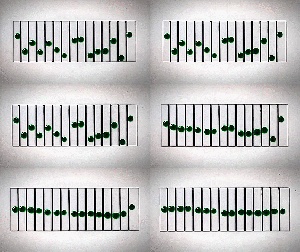
What makes drops of food coloring able to dance, chase, sort themselves, or align with one another? This unexpected behavior is a consequence of food coloring consisting of two mixed liquids: water and propylene glycol. Both have their own surface tension properties and evaporation rates, which ultimately drives the behavior you see in the animations above. Both long-range and short-range interactions are observed. The former are due to vapor from each droplet adsorbing onto the glass around the droplet, thereby changing the local surface tension and causing nearby drops to feel an attractive force. The short-range effects are also surface-tension-driven. Droplets with lower surface tension will naturally try to flow toward areas of higher surface tension, which causes them to “chase” dissimilar adjacent drops. You can learn more about the research in the videos linked below (especially the last two), or you can read about the work in this article or the original research paper. (Image credit: N. Cira et al., source videos 1, 2, 3, 4; GIFs via freshphotons; submitted by entropy-perturbation)


Rare brass handled katar dagger mounted with two flintlock pistols, originates from India, 18th or early 19th century.



 Escapes from Apathy